
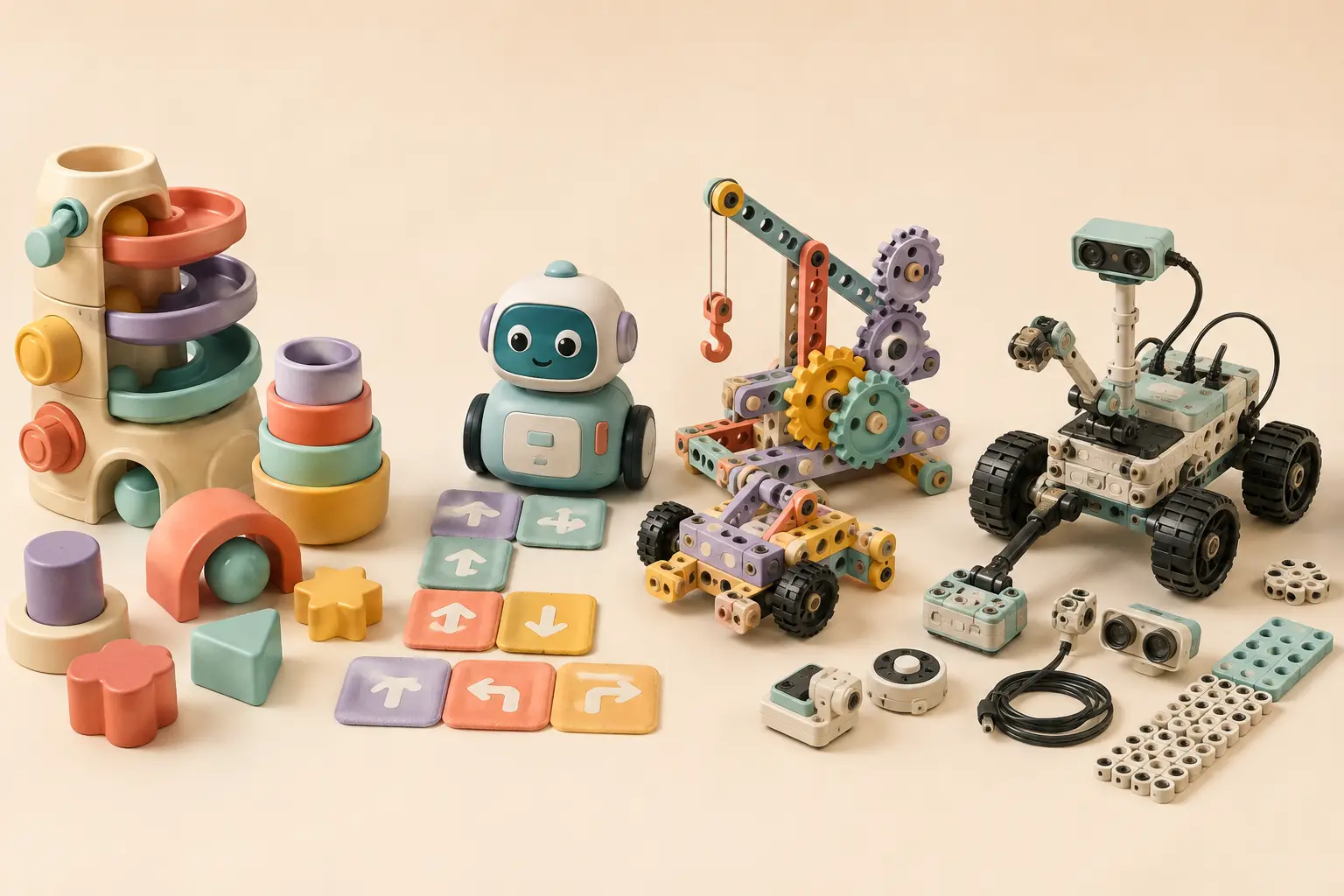
New 2026 science and building alternatives for age six
Our September product scan added several age-matched options outside robotics. The National Geographic Build a Bee Habitat combines construction, decorating and pollinator observation; the Great White Shark Dissection Lab introduces hands-on anatomy; and the Barbie Sparkle Marble Run turns track building into gravity and engineering experiments. For open-ended making, compare Boxineers Cardboard Vehicles; for pattern and spatial work, see STEM Explorers Pixel Art Pro.
What changes around age six?
Compared with many five-year-olds, a six-year-old may be ready to hold a longer plan in mind, read simple symbols or instructions, recover from a failed attempt with less adult help and connect code to a creative goal. That makes loops, multi-step routes, model building and beginner app-based block coding more practical.
| Pick | Best for | Screen? | Why it fits age 6 |
|---|---|---|---|
| Botley 2.0 | Independent screen-free coding | No | Ages 5+; supports longer routes, loops, obstacle sensing and sequences up to 150 steps. |
| Kids First Coding & Robotics | Structured physical coding | No | K–2-aligned lessons cover algorithms, loops, functions, conditions and debugging through models and code cards. |
| Wonder Workshop Dash | Creative app-based robotics | Yes | Wonder Workshop says its Dash apps are designed for kids ages 6+ and teach sequences, loops, events and conditions. |
| LEGO Education CS & AI K–2 | Hands-on CS and AI | Web/iOS coding canvas | K–2 curriculum combines building, hardware, sequences, events, loops and AI/data concepts. |
Best overall for low-friction coding: Botley 2.0
Botley still earns the top spot because the child can program the robot directly without a tablet. Learning Resources says it is for ages 5+ and can handle sequences up to 150 steps, 45-degree turns, obstacle sensing and multiple coding modes. At six, those deeper options provide room to grow beyond the first maze.
Best screen-free curriculum: Kids First Coding & Robotics
This Thames & Kosmos kit is more structured and piece-heavy than Botley. Its curriculum materials map activities to K–2 computer-science concepts such as algorithms, sequences, loops and debugging, while later lessons also introduce ideas such as conditions and functions. It suits a six-year-old who enjoys building models and can tolerate a little more setup.
Best app-based step up: Wonder Workshop Dash
Dash makes sense when the family is comfortable using a compatible device and wants a robot that can grow into more open-ended programming. Wonder Workshop's current trust-and-safety page says its Dash and Dot mobile apps are designed for kids ages 6+ and do not require associated user accounts. Its at-home materials describe coding with loops, events, conditions and sequences, plus accessories that can turn programs into drawing, carrying and launching challenges.
The tradeoff is screen and device setup. If the goal is “no tablet,” Botley or Kids First is the cleaner fit.
Best classroom-style CS/AI option: LEGO Education K–2
LEGO Education's Computer Science & AI K–2 system combines 276 bricks, a motor, color sensor and 30 lessons. The current K–2 progression includes hardware, events, sequences, loops and AI/data. LEGO also says student projects are saved locally and lessons are accessed by PIN instead of student logins. The main drawback for home buyers is price and classroom orientation.
Three questions before buying
- Does the child want to build, program or explore? Choose the activity first and the “smart” feature second.
- How much adult setup is acceptable? A robot that works in minutes may create more independent practice than a more advanced kit that needs constant troubleshooting.
- Will the next challenge be child-created? Replay value improves when the child can invent a new route, rule, model or program after finishing the included activities.
Age 5 or age 6?
If the child is new to sequencing or still prefers very short story-based tasks, the STEM toys for 5-year-olds guide starts with gentler options. If they already plan multi-step routes and enjoy debugging, the age-six picks here offer more progression.