
Quick comparison
| Robot | Current manufacturer fit | Child enters code with | Screen | Best reason to choose it |
|---|---|---|---|---|
| Tale-Bot Pro | Ages 3–5 / PreK–K | Buttons on robot | None | Storytelling + first sequences |
| Sphero indi | Grades PK–3 / ages 4+ | Color tiles, later blocks | None at first | Visible cause-and-effect debugging |
| Botley 2.0 | Ages 5+ | Handheld programmer | None | Longer 150-step routes |
| Wonder Workshop Dash | Roughly ages 5–14 | Visual/Blockly apps | Required | Longest beginner-to-advanced runway |
1. Tale-Bot Pro: best for preschool storytelling
MatataStudio positions Tale-Bot Pro for ages 3–5. Children press command buttons directly on the robot, then run the sequence. It teaches commands, sequences and loops while adding drawing, dancing, recording and story maps. The recording feature is especially useful for children who will code a character through a story but ignore an abstract maze.
Choose it when: the child loves pretend play and needs no-reading, no-screen controls. Think twice when: the goal is a multi-year path into block or text coding.
2. Sphero indi: best visual first coding robot
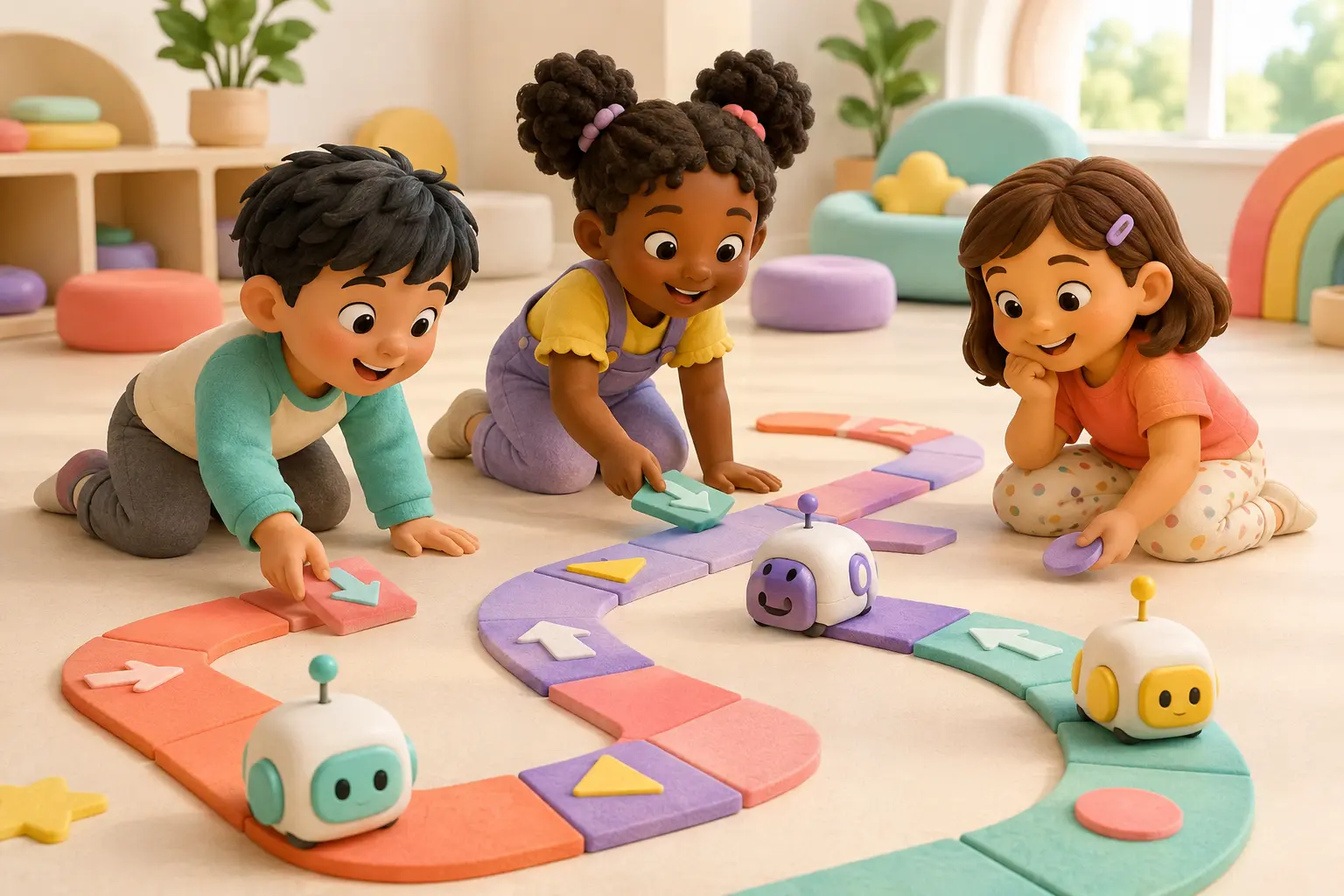
Sphero currently positions indi for grades PK–3 and ages 4+. The screen-free starting mechanic is unusually concrete: each color tile changes what the robot does. Children can swap one tile, run the course again and immediately see whether the change fixed the problem. When they are ready, Sphero Edu Jr adds block coding.
Sphero currently lists the indi Student Kit at $150. The manufacturer page also notes current backorder timing, so check availability before planning a birthday or classroom date.
Choose it when: the child learns best through patterns, movement and visible changes. Think twice when: floor space is tight or the child already understands block programs.
3. Botley 2.0: best longer screen-free sequences
Learning Resources labels Botley 2.0 for ages 5+. It uses a handheld programmer rather than an app, supports six directions including 45-degree turns, object detection and sequences up to 150 steps. The 78-piece Activity Set adds coding cards, obstacles and building pieces for repeated maze and route challenges.
Choose it when: the child likes planning routes and can hold several steps in mind. Think twice when: the child needs a stronger story or character layer to stay engaged.
4. Dash: best beginner robot with room to grow
Wonder Workshop now positions Dash across roughly ages 5–14. That broad range makes sense because the same robot can start with visual activities and progress into Blockly concepts such as loops, events, functions, variables and conditionals; optional Blockly Pro extends toward JavaScript and Python. The tradeoff is a compatible device and a screen.
Dash currently sells for $189.99 through Wonder Workshop's current storefront. The robot connects locally to the coding device over Bluetooth and does not contain a camera, although downloads, updates and platform features can require internet access.
Choose it when: the child is ready for app-based coding and you want a robot that can remain useful for years. Think twice when: screen-free play is the goal or you have not confirmed device compatibility.
When an 8-year-old should skip the beginner tier
If the child already understands sequences, loops and debugging, do not buy a preschool-style robot just because the box says STEM. Two stronger next-step options are Sphero BOLT+, which moves from Draw/Block coding into JavaScript and Python, and PYXEL, which uses Blockly and Python through its own local Wi-Fi connection.
How to tell whether a robot really teaches coding
They can say or point to what should happen before pressing go.
A route, light, drawing, sound or behavior shows what the commands did.
The child can change one command and try again without starting over.
Three buying traps
- Buying too advanced: a longer feature list does not help when the adult performs every setup step.
- Confusing remote control with coding: direct driving can be fun, but coding means entering a plan that executes afterward.
- Ignoring the upgrade path: a robot can be perfect for month one and still become too shallow by month three. Match the runway to the child's current skill, not just age.
Privacy and setup differences
Tale-Bot Pro and Botley are the lightest connected-data choices because their core coding does not depend on a companion app. indi starts screen-free and adds an optional Bluetooth app pathway. Dash depends on a coding device but does not have a camera and communicates with the robot over Bluetooth. For any app-based product, keep the adult in control of accounts and permissions.
FAQ
What is the best first coding robot for a preschooler?
For ages 3–5, Tale-Bot Pro is the clearest story-first screen-free choice. For age 4+ children motivated by movement and visual patterns, indi's color tiles make debugging especially concrete.
What is the best screen-free coding robot for age 5 or 6?
Botley 2.0 is a strong step up because it stays screen-free while supporting sequences up to 150 steps, object detection and 45-degree turns.
Which beginner robot grows the farthest?
Dash. It requires a compatible device, but its coding progression extends much further than the other three picks.
Should an 8-year-old start with BOLT+ or PYXEL instead?
Possibly. If the child already understands loops and debugging, BOLT+ or PYXEL can provide more challenge. If coding is completely new, a simpler first robot may still produce faster independent success.