
Current owner signal
Upper Story displayed 5,272 customer reviews when checked September 4, 2026, with 91% five-star. This is a direct-store signal, not a NextGenBabyPlay rating and not a combined score across retailers.
Who this fits best
Best fit: ages-eight-plus puzzle solvers who enjoy seeing how a system works, are willing to work through a progression of challenges, and would rather manipulate physical parts than start with programming syntax on a screen.
What comes in the standard kit?
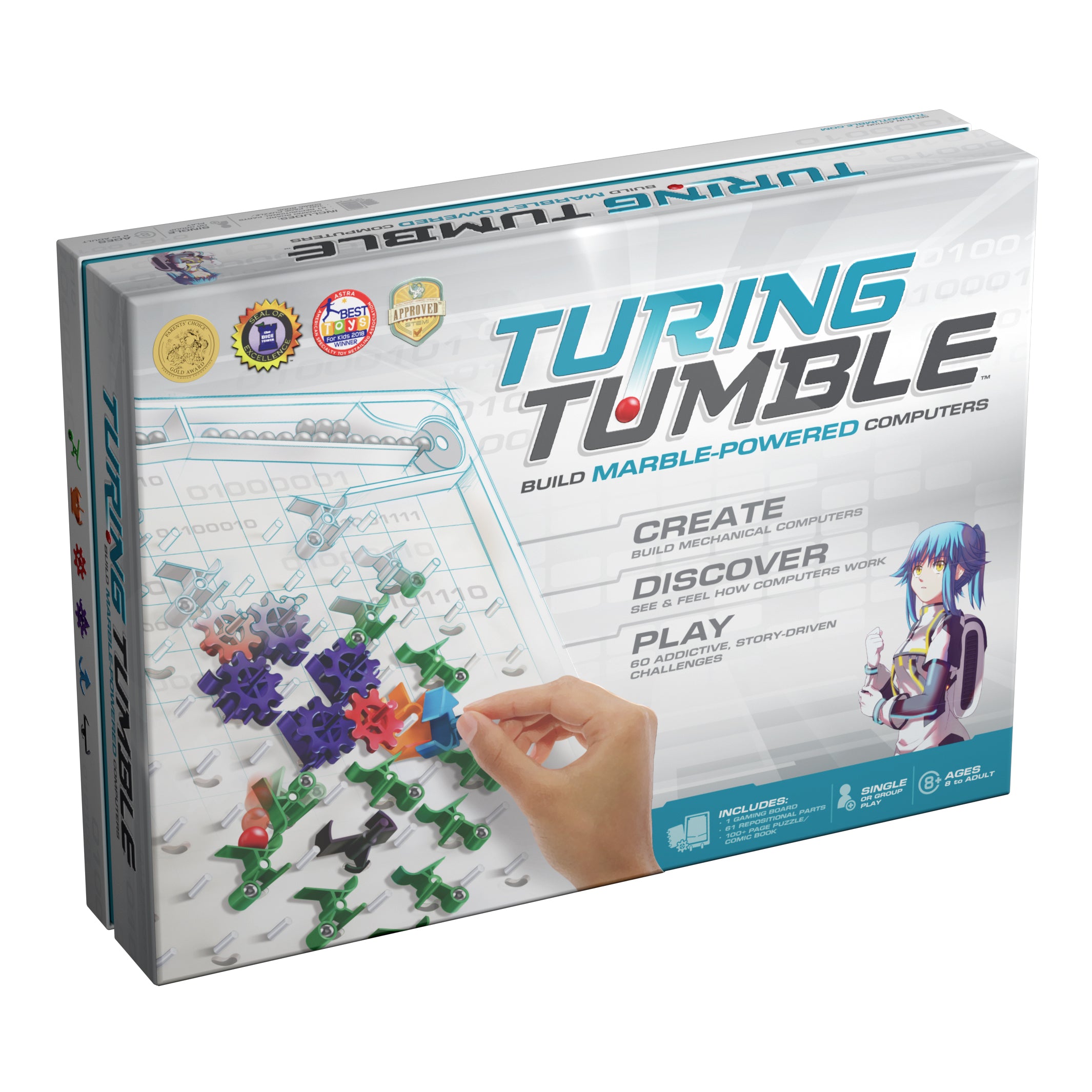
Upper Story currently lists the computer board and stand, 30 ramps, 10 bits, eight gear bits, six crossovers, four gears, three interceptors, one presser, 20 red marbles, 20 blue marbles, 30 counterweights, eight high-friction washers and the 60-puzzle comic book.
What do the 60 puzzles teach?
The puzzles use physical pieces to represent computational ideas. A bit can store a left/right state similar to a binary 0/1; gear bits and connected mechanisms let players create more complex logic. Upper Story says the system can generate patterns, perform logic and model arithmetic operations.
This is different from learning JavaScript, Python or block coding. The educational strength is understanding how computation can be built from simple rules and states before worrying about programming-language syntax.
Turing Tumble vs. Spintronics
Both Upper Story products are screen-free, puzzle-driven systems. Spintronics Act One models electronic circuits with mechanical chains; Turing Tumble focuses on computational logic with marbles, bits and gears. Choose based on whether the learner is more interested in computer logic or circuit behavior.
Strengths
- 60 puzzles create a long structured learning runway
- No batteries, app, Wi-Fi or account required
- Physical bits and gears make computer concepts observable
- Works for older children, teens and adults rather than a narrow age band
Tradeoffs
- Many marbles and small parts require careful storage
- Progress depends on enjoying puzzle solving
- It teaches logic concepts, not programming syntax
- $76.95 is more than many entry-level logic games
Safety and storage
For second-hand sets, verify that all puzzle-critical parts and marbles are present before purchase. Use the Toy Safety Center to check current recall information.
Is it worth $76.95?
The price is easier to justify for a learner who likes progressive logic challenges and is likely to work through a meaningful portion of the 60-puzzle book. A child who mainly wants free-form marble play may get better value from a conventional marble run; a child who wants robotics should compare a programmable robot instead.
Verdict
Turing Tumble is one of the clearest ways to make abstract computer logic physically visible without putting a child in front of a programming app. Its value comes from the 60-puzzle progression and reusable logic parts, not free-form marble-run play. For puzzle-minded learners ages eight and up, the current $76.95 price buys substantially more conceptual depth than a one-project STEM kit.