
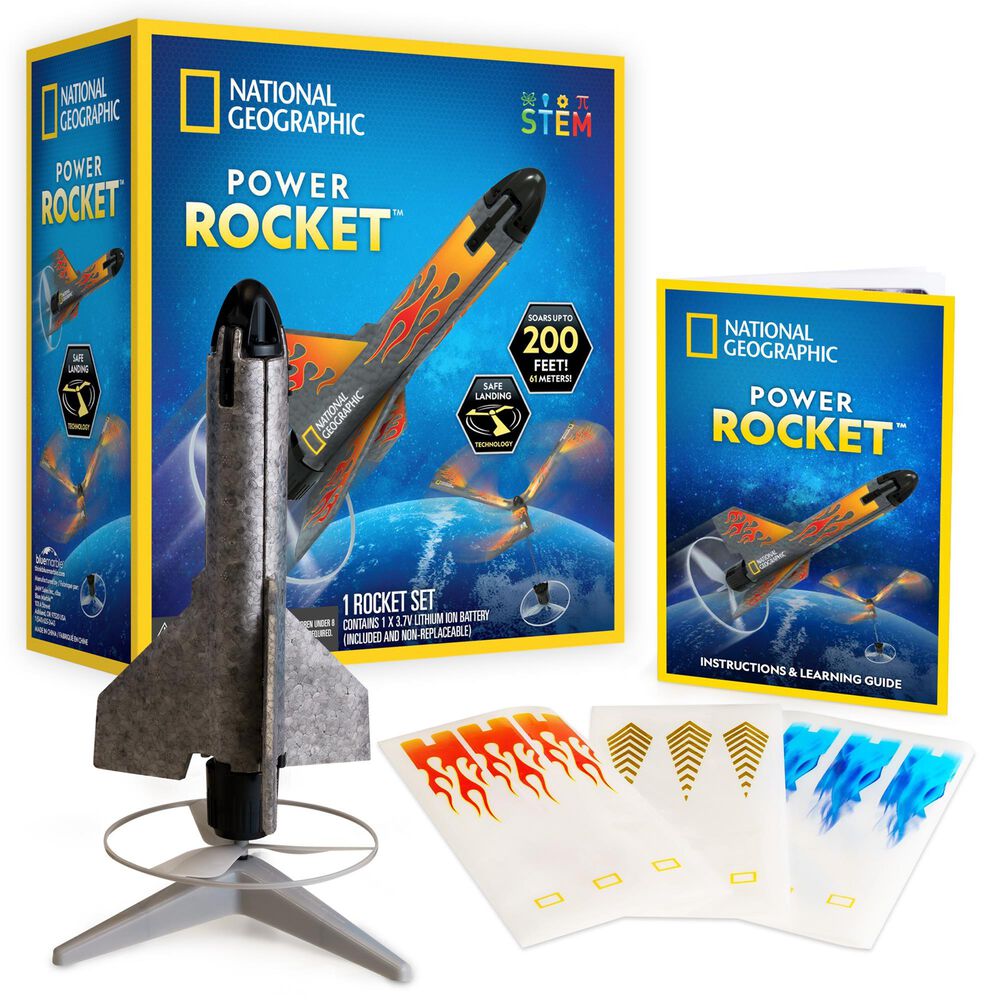
How the Power Rocket works
The built-in electric motor drives the launch. Pressing the launch control selects among three flight durations, so children can compare shorter and longer flights instead of replacing single-use propulsion. Blue Marble says the rocket can reach up to 200 feet and provide up to 20 launches on a charge.
What happens on the way down?
At the top of the flight, rotor-style blades deploy and spin as the rocket returns. That landing mechanism makes descent itself part of the engineering discussion: ascent depends on powered thrust, while the return uses drag and autorotation-like behavior to slow the fall.
What is actually in the box?
The manufacturer lists the rechargeable Power Rocket, launch pad, charging cable, three decal sheets, instructions and a learning guide. The guide covers flight, aerodynamics and space, which gives adults a ready way to connect repeated launches with more than “how high did it go?”
Current price and availability
Blue Marble listed the kit for $39.99 at our September 10 check, and Walmart also showed $39.99 with dozens of customer reviews. Inventory and sale pricing can change, so verify the current retailer before buying.
Safety matters more than maximum height
This is an outdoor projectile. Use a large open area, follow the included launch-distance guidance, supervise every flight and avoid roads, people, buildings, trees, power lines and other hazards. Wind can carry a returning rocket away from the launch point, so a calm day and generous recovery space are better than trying to reach the highest possible flight in a cramped yard.
Strengths
- Rechargeable instead of relying on disposable rocket motors
- Three modes invite repeat testing
- Up to 20 launches per charge
- Strong aerodynamics and outdoor-science connection
- Rotor return adds another visible engineering principle
Tradeoffs
- Needs substantial outdoor space
- Wind can complicate recovery
- Adult supervision is important
- Actual height will depend on conditions
Verdict
For a child interested in rockets, flight or repeated experiments, the Power Rocket offers more iteration than a one-and-done novelty launcher. The best use is not simply chasing 200 feet; it is changing the launch mode, observing what happens and turning each flight into a small test.