
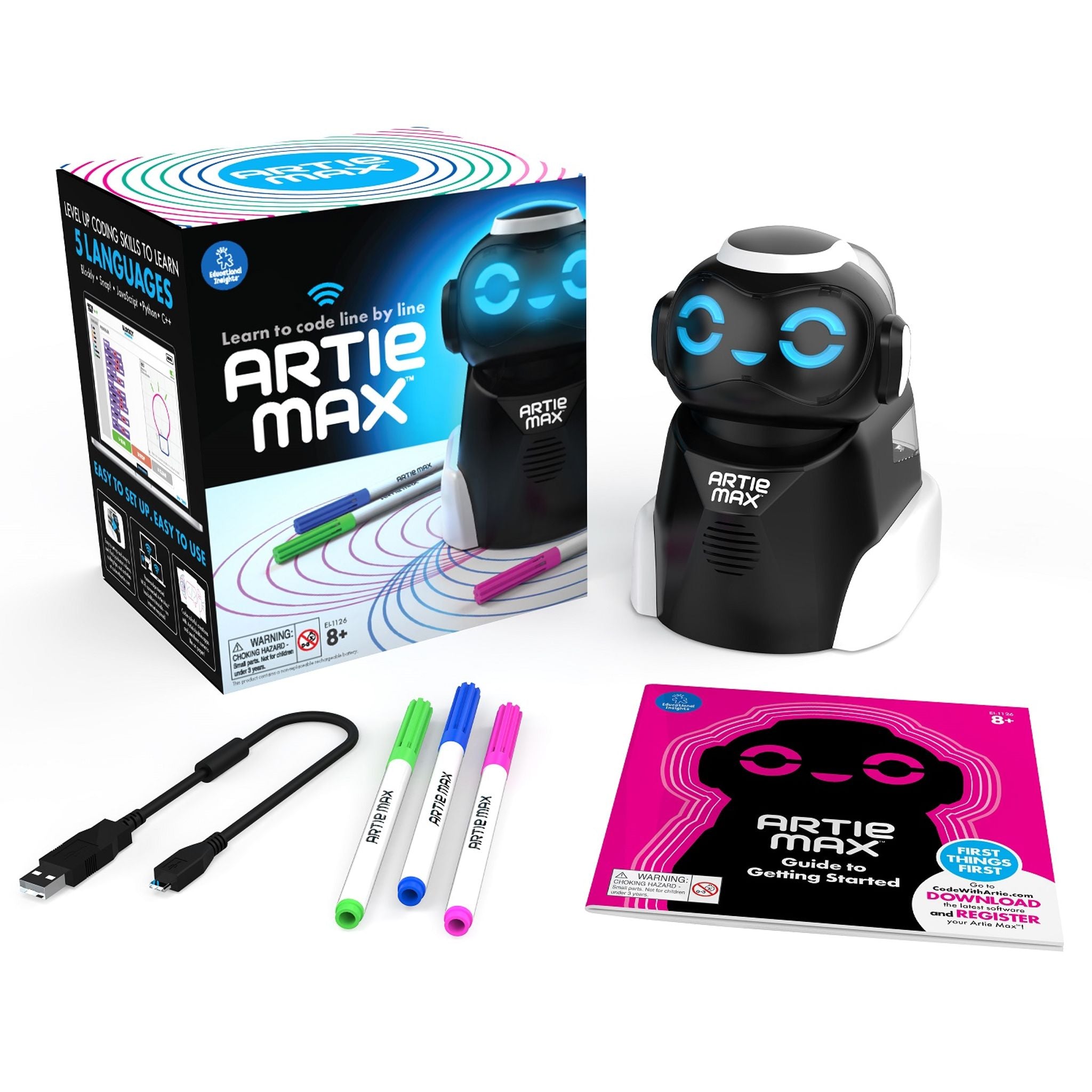
Who Artie Max fits best
Best fit: an age-8+ learner who likes art enough that seeing code become a drawing will make debugging and programming feel rewarding.
Five coding languages create a real growth path
Educational Insights lists Blockly, Snap!, JavaScript, Python and C++. That matters because a child can begin with drag-and-drop logic and later type text-based code without replacing the robot. The drawing output remains the same feedback mechanism as the syntax becomes more advanced.
No internet and no app required
Artie Max creates a password-protected local Wi-Fi hotspot. A Wi-Fi-enabled tablet or computer connects directly to Artie's built-in interface; the robot does not need internet service or a separate app for core coding. This is a simpler privacy/service-dependence model than cloud-connected learning toys.
Why drawing is useful for debugging
Artie's physical output makes mistakes visible. If a square does not close or a pattern bends the wrong way, the child has a concrete artifact to inspect. That naturally encourages prediction, coordinate/spatial thinking, sequencing and iterative debugging.
What comes in the box
Educational Insights currently lists three interchangeable colored markers, a rechargeable battery, micro-USB charging cord, sticker sheet, built-in user interface and guide booklet. Paper remains a household consumable, and replacement markers/materials are part of long-term use.
Setup and workspace burden
Artie needs a flat protected drawing area and enough room to move over the paper. Calibration, marker placement and surface protection matter more here than with a stationary coding interface. Younger or first-time users may need adult help getting the local Wi-Fi connection and drawing area set up correctly.
Strengths
- Five-language path from blocks to real text coding
- No internet or app required for core use
- Physical artwork makes code behavior visible
- Rechargeable battery included
Tradeoffs
- Tablet/computer is still required to write code
- Needs paper, markers and protected workspace
- $139.99 is premium if the art-coding crossover does not motivate the child
- Less robotics/sensor depth than mBot2 or Dash
Artie Max vs. PYXEL or mBot2
Choose Artie Max for the widest language list and code-to-art feedback. Choose PYXEL when the pet form factor will motivate Blockly/Python practice. Choose mBot2 when mechanical robotics and sensors matter more than drawing.
Verdict
Artie Max has a clearer educational identity than a generic “coding robot”: code is transformed into a physical drawing the child can inspect and revise. Its five-language progression and local-only connection make it especially strong for an art-motivated age-8+ learner who is ready to grow beyond blocks, provided the family accepts the screen and workspace requirements.