
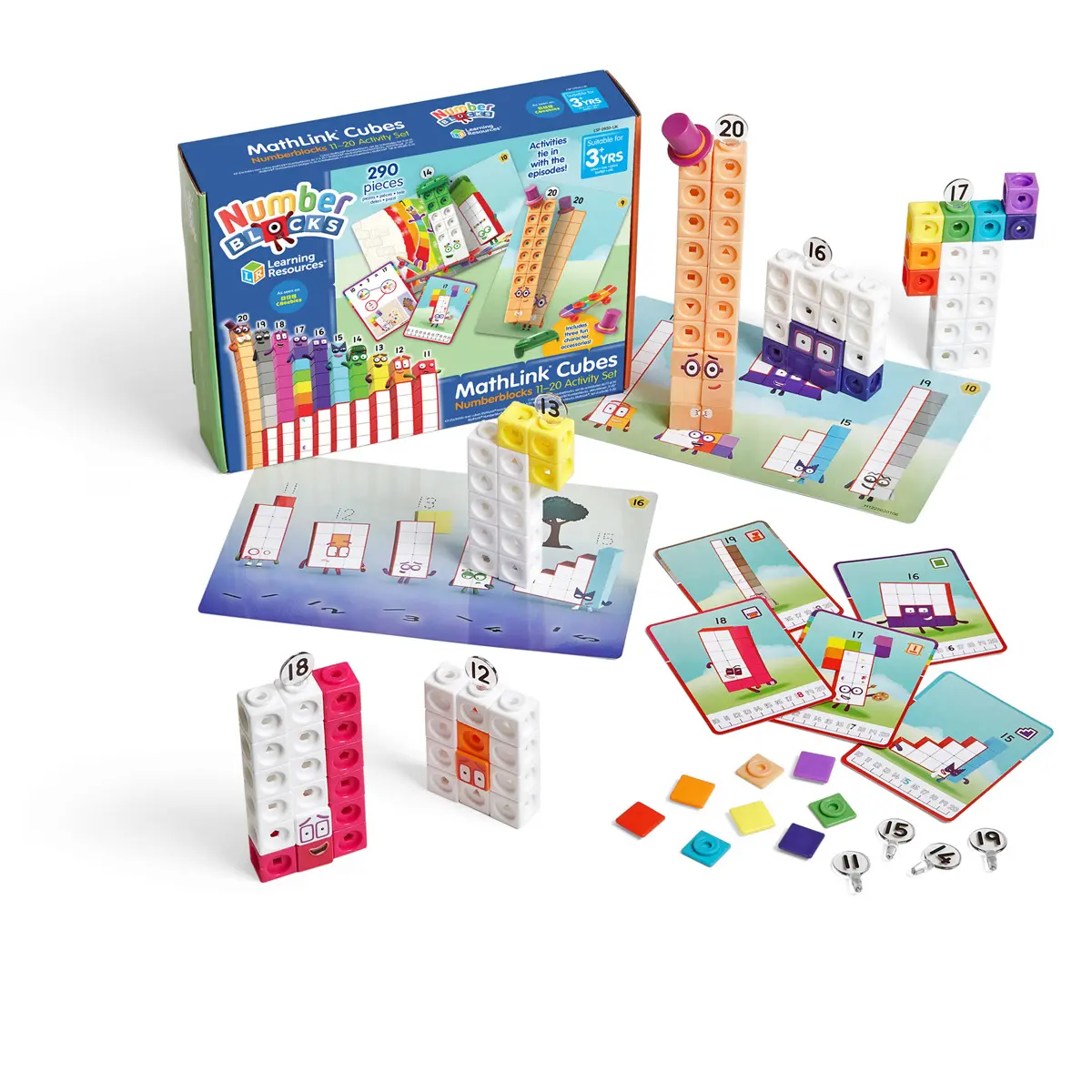
Owner feedback status
We found no stable aggregate owner rating in an approved source during this audit, so this page does not estimate or invent a star score.
Who this fits best
Best fit: Numberblocks fans beginning to work seriously with numbers 11–20 and adults who want a concrete way to connect the characters to real quantities.
Strengths
- Characters connect abstract teen numbers to physical quantities
- 290 cubes support many models beyond one activity
- Hands-on counting and place-value practice is easy to repeat
Tradeoffs
- 290 pieces need organized storage
- Strongest appeal is for children who know the Numberblocks characters
- Small cubes need careful management around younger siblings
What does it teach?
The strongest use is building Eleven through Twenty, comparing quantities, breaking numbers apart, recombining them and seeing how teen numbers relate to groups of ten and additional ones. Adults can extend the set by asking children to show the same number in more than one arrangement.
Is 290 pieces manageable?
The large cube count creates learning flexibility, but storage matters. A labeled bin or divided container can prevent cleanup from becoming the reason the set stops getting used.
Safety check
Use the Toy Safety Center for current small-parts and recall guidance.
FAQ
What age is the Numberblocks 11–20 set for?
The reviewed set is marked for ages 3+.
How many cubes does it include?
290 MathLink cubes.
What math skills does it practice?
Counting, quantities 11–20, composing and decomposing numbers, and early place-value ideas.
Verdict
The Numberblocks 11–20 set is strongest when the child already cares about the characters and is ready to turn teen numbers into physical quantities. Its educational value is real and repeatable; its practical downside is simply managing 290 small pieces.